Research
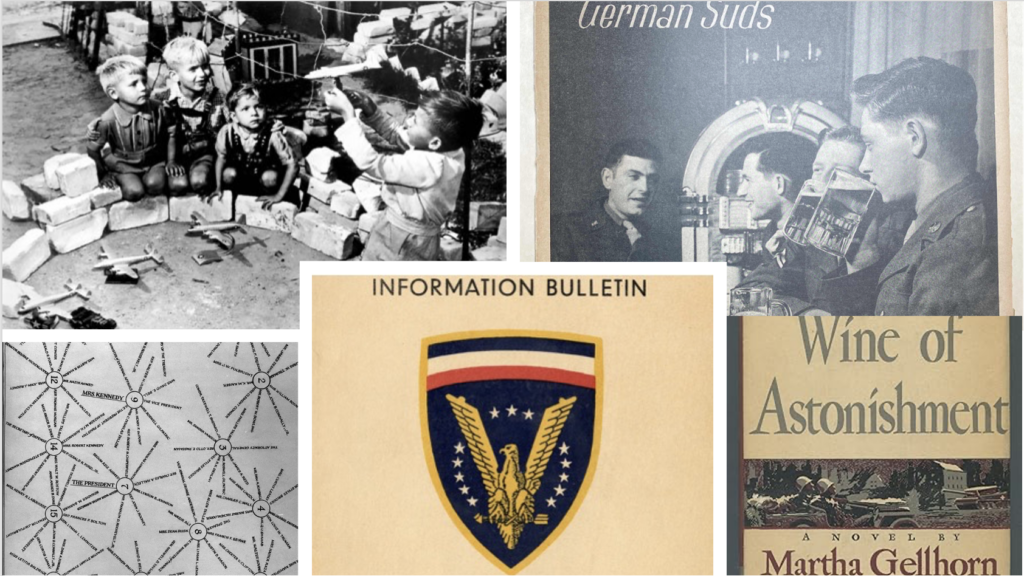
My research examines how everyday practices, from food aid to drinking cultures, shaped the exercise of American military and diplomatic power in the 20th century, particularly during World War II and the early Cold War.
Book Projects
On the Rocks: Alcohol and the American Military Experience Overseas
This project examines the role of alcohol in the history of U.S. military power. From Caribbean outposts at the turn of the century to the Global War on Terror, it explores how drinking shaped encounters between American service members and local populations. By tracing alcohol’s place in diplomacy, occupation, and everyday social life, the project reveals how informal practices influenced the projection of American power abroad.
1948: The Collapse of the Postwar Imagination
This book argues that 1948 marked the collapse of the postwar moment and the consolidation of the Cold War order. Linking events such as the assassination of Gandhi, the Communist coup in Czechoslovakia, the Marshall Plan, the establishment of the Republic of Korea, and intensifying anti-communism in the United States, the project examines how global crises and domestic struggles forced Americans to redefine democracy in a newly bipolar world.
Articles
Alongside my book projects, I am wrapping up several article-length studies that explore the cultural and political dimensions of American power.
- “Food Fights: The Berlin Uprising and the Aid that Failed to Spark a Revolution” in Forum: Food and U.S. Foreign Relations, Diplomatic History, revise and resubmit, (forum organizer)
- “Brewing Tensions: Bier, GIs, and Civil-Military Dynamics in Postwar Germany,” War & Society, in preparation
- “Photo Essay: The Art of the State Dinner in the Kennedy White House,” Modern American History, in progress
Collaborative Projects
Beyond Liberation: U.S. Military Encounters with the Holocaust
This edited volume grew out of a two-week workshop I co-convened with Dr. Adam Seipp (Texas A&M University) at the United States Holocaust Memorial Museum in July 2024. During the invasion of German-occupied Europe and for years thereafter, military personnel encountered and interacted in a variety of ways with the millions of surviving victims of the Holocaust, forced labor, and other crimes of the Nazi regime. The armed forces played a critical role in managing the chaotic and uncertain transition from war to peace after 1945. These individuals were not simply soldiers—they were lawyers, photographers, journalists, burgeoning intelligence operatives, and relief workers. The volume, including my own contribution “Liberation’s Afterlives: Mediating Atrocity in Postwar America,” weaves together U.S. military history and Holocaust Studies to better understand the complex web of relationships that emerged during the transition from war to peace.
Digital Public History – Mapping America’s Postwar Project in Germany, 1945–1955
This digital public history project, created with Dr. Amanda Regan (Clemson University), visualizes the U.S. occupation of Germany by mapping the Military Government Weekly Information Bulletin, produced by the Office of Military Government, United States (OMGUS). These bulletins recorded the weekly activities, priorities, and challenges facing American occupation authorities, from food distribution and denazification to economic reconstruction and political reform. The project maps these reports to reveal how the occupation unfolded across time and space. Users will be able to explore the geography of American policy by filtering places, institutions, and events, offering a new way to trace how the United States attempted to rebuild Germany and reshape the postwar world.