Conferences
Throughout my career, I’ve organized several academic conferences and workshops of various sizes and for various audiences. I also have organized the Society for Historians of American Foreign Relations (SHAFR) annual meeting since 2022. You can find more info below.
SHAFR Annual Meetings


Recipes for Resilience
Yale Brady-Johnson Program in Grand Strategy & Yale Sustainable Food Program
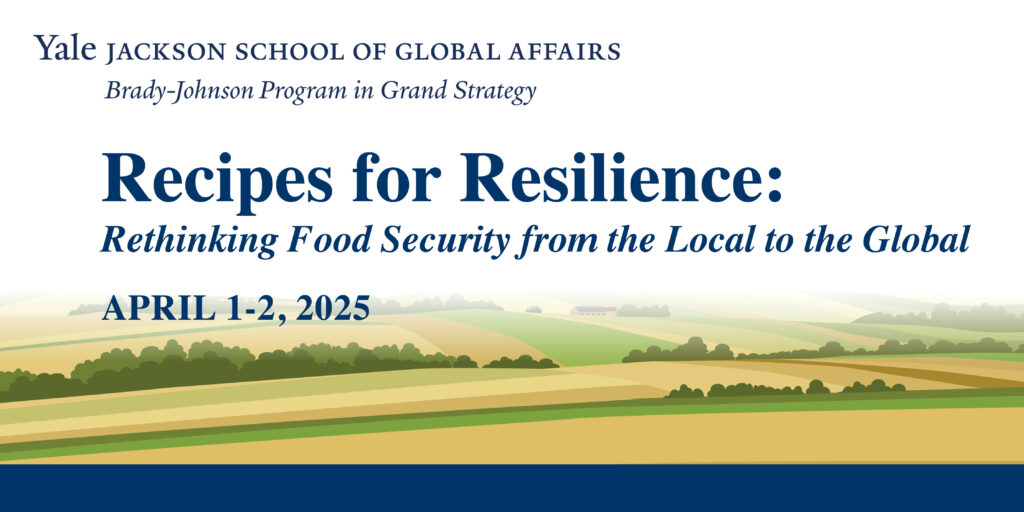
Hosted by the Brady-Johnson Program in Grand Strategy, in collaboration with the Yale Sustainable Food Program, Recipes for Resilience: Rethinking Food Security from the Local to the Global explored the critical issues shaping global food systems, with a focus on access, sustainability, and power dynamics. The event brought together scholars, practitioners, and leaders for two days of programming at Yale’s Greenberg Conference Center, April 1st and 2nd, 2025.
Through a series of panels, discussions, and presentations by leading experts, attendees engaged with urgent issues such as the climate crisis, equitable food access, the weaponization of food, and the role of innovation in overcoming obstacles to food security. This conference offered a unique opportunity for those interested in food studies to deepen their understanding of the diverse and interconnected aspects of food systems.
Lessons and Legacies of Iraq
Yale International Security Studies & Yale International Leadership Center

On March 20, 2003, a U.S. led coalition launched a shock and awe bombing campaign of Iraq before invading the country as part of President George W. Bush’s Global War on Terror. The United States couched its rationale on false claims that Iraq was stockpiling Weapons of Mass Destruction and Saddam Hussein was supporting al-Qaeda. The invasion overthrew the Ba’athist regime in a matter of weeks and Hussein was captured in December. Far from a swift victory, the conflict continued as coalition forces fought a growing insurgency and the new Iraqi government struggled to gain legitimacy. U.S. troops officially withdrew in 2011, only to return in 2014 to fight ISIS. 2,500 U.S. troops remain in Iraq today.
In addition to reflecting on the historical significance of the invasion, surge, and withdrawal, this symposium examines the implications of these events on current political, military, and policymaking conversations. Much like Vietnam, the ghosts of 2003 can be found stalking the halls of the Pentagon, wandering VA hospitals, as talking heads on cable news, and in refugee camps across the Middle East. Largely regarded a failure, one is left to ask what, if anything, did the U.S. learn from the Iraq War? And perhaps more importantly, how are these lessons being applied in 2023?
Temple University


